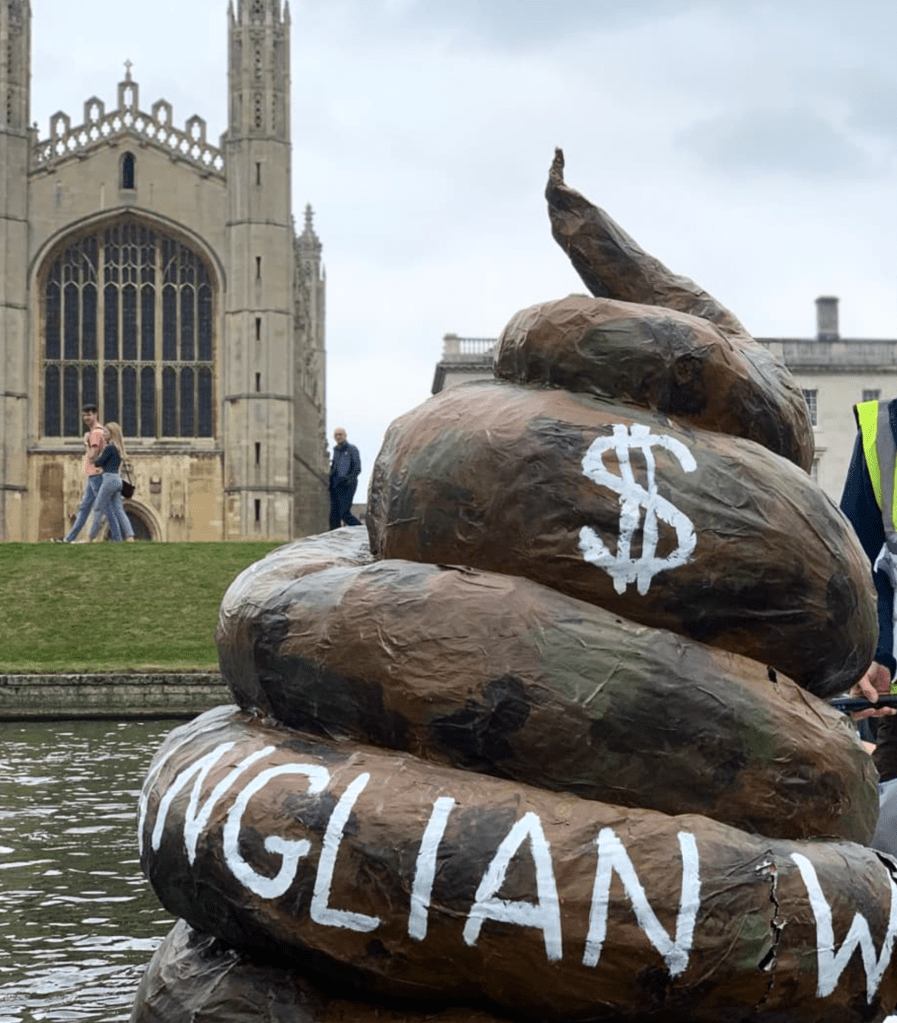
Anglian Water announced its consecration as “Utility of the Year” last week. Chief Executive Peter Simpson observed that the award reflected their “leadership in environmental protection”. I hope Peter and Anglian Water will forgive me for being somewhat bemused, as this announcement was followed by the publication of the industry’s annual returns of storm overflows. That’s code for saying how much raw sewage escapes into our rivers and seas. Which is a lot.
In 2020, across its network, Anglian showed 17,428 separate incidents of the escape of raw sewage for a total of 170,547 hours. That’s nearly 20 years of poo entering our rivers and around 5.5% of the industry total. The new figures indeed show awarding-winning progress, with 21,351 incidents (up 22.5%) for a total of 194,594 hours or 22.2 years of flowing excrement, and a market share of 7.3%.
How has it come to this? Perhaps a perfect storm of weak and resource-starved regulation and lack of public awareness, (although the kraken that is public opinion is slowly waking). More likely however is a systematic underinvestment in infrastructure and leak repair by the water companies, who are generally run under financial strategies designed to maximise shareholder return at the expense of environmental benefit. A quick look at the Anglian Water shareholder base shows global pension schemes, sovereign and institutional investors who may not see the preservation of local chalk streams as important daily business.
The shareholders in Anglian Water Group Limited, the ultimate parent company, are as follows:
32.9%: CPP Investments of Canada, the Canadian Pension Plan which has c. 20 million contributors and beneficiaries, or 53% of the population of Canada.
19.8%: IFM Global Infrastructure Fund, an Australian fund manager managing the pensions of 120 million people in Australia and elsewhere.
16.7%: Infinity Investments, owned by the state of Abu Dhabi, who also own Manchester City FC.
15.6%: First Sentier, an Australian institutional and pension fund investor.
15.0%: Camulodunum, jointly owned by Dalmore (1.3 million UK pension holders) and GLIL, the pensions arm of Greater Manchester, Merseyside, West Yorks and the Local Pensions Partnership. (By way of digression, Camulodunum was the capital of Roman Britannia taken out by Boudicca in 61AD. I can’t help thinking that things would be somewhat different if she were head of the Environment Agency.)
These are the owners who seemingly tolerate the increasing pollution of the chalk stream infrastructure of the Cam. To bring matters closer to home, we might look at the recently published statistics for the storm tanks in Haslingfield (which discharges into the Rhee and then the Cam), Melbourn (which discharges into the Mel, the Rhee and then the Cam) and Barrington (into the Rhee and then the Cam). For any geographically challenged shareholders, this is less than four miles from Grantchester Meadows (once a popular location for wild swimming) and five miles from King’s College.
In 2020, the plant at Haslingfield recorded 49 overflow incidents for a total of 428 hours (17.8 days of flowing sewage). The newly-published figures for 2021 show 82 incidents (+67%) for 1,013 hours (42 days, up 137%).
The figures for Melbourn show 62 incidents for 93 hours (3.9 days) in 2020, rising to 80 leaks for 216 hours (9 days, up 123%).
The Barrington site shows a similar pattern of increase with 4 incidents for 16 hours in 2020, rising to 12 for 20 hours in 2021.
With this rising tide of pollution, it is perhaps unsurprising that the Environment Agency announced in September 2020 that not a single lake or river in England could be classed as “Good” in 2019, down from 16% in 2016. This is despite its own target that all waters should be in good health by 2027. This problem of pollution is exacerbated by the lower flows resulting from overabstraction by other water companies, but that’s a story for another day.
By way of further digression, the WWF makes the following observation: “Some of our most beautiful rivers are ‘chalk streams’. Their pure, clear, constant water from underground chalk aquifers and springs, flowing across flinty gravel beds, make them perfect sources of clean water – and ideal for lots of wild creatures to breed and thrive. We’re lucky because the majority of the world’s chalk streams are found in England.”
Pure, clear water? Not with 52 days of raw sewage into the Cam in 2021.
It’s hard to avoid the conclusion that systematic underinvestment is responsible for what appears to be a worsening situation. Anglian Water will doubtless point to annual network investment of £339 million. Others might point to the dividend of £68 million in 2020 and a proposed dividend of £96 million (plus any other internal financing that may exist to extract value). Although these appear to go towards group debt repayment rather than to the ultimate shareholders, they still diminish the ability of the principal operating subsidiary to invest in its network and still enhance shareholder value. A stronger regulator might wish to limit future dividend payments and executive incentives until substantial improvements can be shown, as pollution fines of £1.4 million in 2021 seem more of a minor occupational irritation than a meaningful disincentive.
What to do?
1) Resource and strengthen the Environment Agency and OfWat.
2) Regulate for serious and accountable pollution reduction plans, with allowable returns directly linked to measurable improvement in water quality.
3) (And arguably the most effective and accessible approach) Use our power as electors to weaponise river pollution as a major political issue requiring urgent action. The Chesham & Amersham by-election in June 2021 recorded a 30% swing against the incumbent following concern about local issues. What better way to focus the minds of our elected representatives?
A day of reckoning must surely come. In the meantime, we can doubtless take consolation in the fact that every passing poop in the Cam is supporting pensioners worldwide and, above all, Manchester City.
Let’s raise a glass (not Cam water, obvs) to the utility of the year!
You may be aware that the Greater Cambridge Planners are in the process of developing a new Local Plan for the City and South Cambs. This will inform long term strategic policies on planning, housing, employment and infrastructure out until 2041. The plan projects a maximum need for 26,300 homes. Across the entire City and South Cambs area.The local authorities are developing a new Local Plan for the City and South Cambs. This will inform long term strategic decisions on planning, housing, employment and infrastructure out until 2041 and take account of climate change, water supply, social inclusion, transport infrastructure, effect on the environment and, crucially, will avoid undue concentration. A strategy will be developed for consultation in the second half of next year.
The local authorities are developing a new Greater Cambridge Local Plan for the City and South Cambs. This is a long and painstaking process that will inform strategic decisions on planning, housing, employment and infrastructure out until 2041, taking account of economic and population growth, climate change, water supply, social inclusion, transport infrastructure and, crucially, will avoid undue negative impact on the local environment. There will be a public consultation on the preferred options in the summer or autumn of 2021. There will be further consultations on the draft Plan in summer of 2022 and again on the Submission Plan in 2023. Approval and adoption are expected in 2024. We will all have our chances to contribute in accordance with the local democratic processes.
I dwell on this long and careful process for reasons that will become apparent. Nobody wants development but new housing stock is necessary if rents and house prices are to become affordable to many of those on whom the local economy depends. If you have to develop, do it in a way that is democratic, transparent and, as far as possible, sensitive and respectful of the character of the areas concerned.
The plan anticipates a maximum need for 26,300 homes across the entire City and South Cambs areaby 2041. As part of this process, 650 sites were submitted in September, which is more than will be needed. Sites will be evaluated against the various strategies and criteria agreed in the final plan.
All of which brings me to the proposal by Messrs Thakeham of West Sussex to build a 25,000 home new town to be sited in and around nine villages. Yes, 25,000. This equates to 95% of the entire area’s maximum housing needs for the next 20 years.
Perhaps more staggering, the development is entirely sited in a confined rural setting that simply will not survive such urbanisation. By way of perspective, some details of the nine villages:
Population
Households
Barrington
1,083
420
Bassingbourn
2,902
1,286
Foxton
1,276
483
Melbourn
4,772
1,978
Meldreth
1,947
705
Orwell
1,046
443
Shepreth
778
306
Whaddon
661
204
Wimpole
301
111
Total
14,766
5,936
Source: Cambridge Insight
Messrs Thakeham of West Sussex thus intend to more than quadruple the number of houses in the green spaces around these villages.
I look again at the Greater Cambridge draft plan of November 2020 and its four overarching themes:
• Climate change– how the plan should contribute to achieving net zero carbon, and the mitigation and adaptation measures that should be required through developments
• Biodiversity and green spaces– how the plan can contribute to our ‘doubling nature’ vision, the improvement of existing, and the creation of new, green spaces
• Wellbeing and social inclusion– how the plan can help spread the benefits of growth, helping to create healthy and inclusive communities
• Great places – how the plan can protect what is already great about the area, and design new developments to create special places and spaces (my emphasis)
and, initially at least, eight different strategies to balance how and where development should occur. These are:
• Densification of existing urban areas
• Edge of Cambridge – outside the Green Belt
• Edge of Cambridge – Green Belt
• Dispersal – new settlements
• Dispersal – villages
• Public transport corridors
• High-tech corridor (southern cluster)
• Growth area around transport nodes (western cluster)
Interestingly, the accompanying research shows the village option to offer by far the worst carbon footprint, as the carbon cost of transport far outweighs any construction benefit.
Be that as it may, and there will be separate occasions to make our opinions of the plan known in the various rounds of consultation, one has to accept that this is a transparent, democratic and evidence-based approach with appropriate public involvement. If you have to develop, this is probably the way to do it.
Which brings me back to Messrs Thakeham of West Sussex, who seem to have chosen not to submit their project along with all the other developers, despite allegedly working on it for two years. The local authorities are apparently expecting a late submission, which, annoyingly, will nonetheless have to be considered to protect the integrity of the planning process.
You have to wonder why Messrs Thakeham of West Sussex have chosen not to play by the rules that applied to everyone else: contempt for the local democratic process based on a belief that they can bypass South Cambs District Council (SCDC) and deal direct with Westminster? The website boasts of the firm’s political connections. It was certainly a relief when Anthony Browne MP and the Ministry confirmed that SCDC will remain in control of the process (although they could lose on appeal). That said, there is also a planning white paper before Parliament that seems to facilitate development and weaken the voice of the local authority. A long game involving the Westminster card should perhaps not be ignored.
A reading of the commitments of Messrs Thakeham of West Sussex to engaging with the local community is particularly humorous. These are as follows:
1. Engagingand working collaboratively with all parts of the local community.
Surprising the local authority with a project that replaces rather than complements the 20-year plan is an odd way of engaging. SCDC’s Lead Cabinet Member for Planning, Cllr Dr. Tumi Hawkins, is quoted as saying: “I want to emphasise that this suggested site will be treated just like any other site put forward. But for that to happen, we need Thakeham to do more than announce an aspiration. If they want us to consider their specific proposals through the Local Plan process it would be helpful for them to provide all the site information we need” (my emphases).
2. Presenting the proposals clearly and honestly.
Where do you start with this? Where’s the map of the site? 15,000 people are blighted until such time as Messrs Thakeham of West Sussex see fit to enlighten us. Where’s the fit with East-West Rail now it has taken the northern option, and the other proposed infrastructure links, such as the A428? How can this be carbon neutral, given that most will commute by car? Where is the water coming from? “We don’t have all the answers to your questions right now”, says the website, so run along and we’ll let you know when we are ready. A disgraceful absence of clarity at a public launch.
3. Adopting an inclusive approach to consultation, using a variety of channels to engage with the community.
For this read a rather vacuous website that plays the Cambridge/ science/ green cards, whilst avoiding any detail or useful information.
4. Listening and responding to feedback at each key stage of the consultation programme.
Whose programme? Where were Messrs Thakeham of West Sussex in the call for sites, a key stage in the local plan process? The launch wasn’t exactly a consultative process either.
5. Being clear about what aspects of the proposals can or cannot be changed as part of the consultation and why.
Am I alone in thinking that this is rather sinister? Is this saying that Messrs Thakeham of West Sussex will tell SCDC, the responsible planning authority, what they can or cannot do? Not my idea of an inclusive approach to consultation (what consultation?) and local democracy.
6. Ensuring the proposals deliver genuine social value for new and existing communities.
How can the destruction of our rural environment possibly bring value to the existing community? I think we know where the value is going here. Mainly to West Sussex.
Readers will have gathered that I am grumpier about this than most things. Both the substance of this project and the manner of its delivery are woeful. On the one hand, we have a long term democratic and strategic process, transparent, evidence-based, subject to repeated rounds of public consultation and backed by over 1,200 pages of research and analysis: 208 pages on how to deliver so many houses over the twenty year period; 155 pages on sustainability; and 42 pages concluding there is a water problem, acknowledging the need for new reservoirs or pipelines.
On the other hand, we have a vague aspiration and a website consisting of platitudes and unsupported assertions.
I know which horse I’d back. Watch this space.
Nick Downer, writing in a strictly personal capacity, January 2021.
The Greater Cambridge planning authority recently published the results of their “call for sites” for possible inclusion in the next local plan. This can be seen at:
There are four sites of relevance to Shepreth. This is early stage stuff and subject to all sorts of consultation and planning approval, but gives an idea of what is coming down the track. It is worth bearing in mind that Shepreth is currently ranked as an “infill” village by the current plan, with development limited to 2 or exceptionally 8 dwellings. The plan goes on to say: “development on any scale [in the infill villages] would be unsustainable”. As a baseline, Shepreth parish has an area of 1318 acres, a population of 768 (2011 census) and, assuming a UK mean of 2.3 people per household, an estimated 334 dwellings.
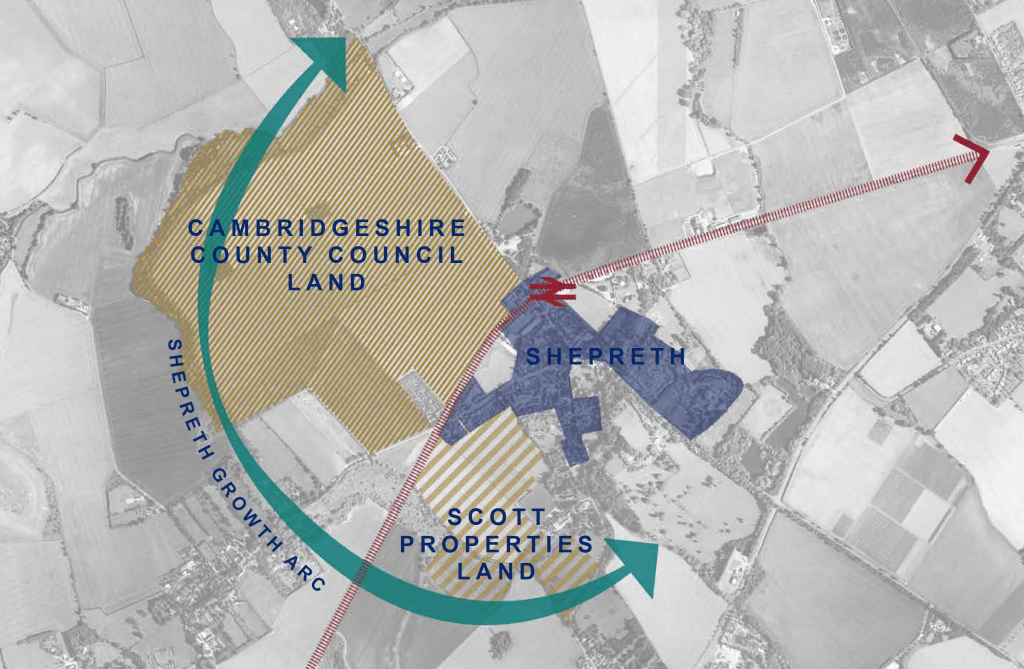
The first site is 59 acres between the High Street and Meldreth Road, going out to the church. Currently agricultural, with up to 240 dwellings proposed. At a UK mean of 2.3 people per dwelling, that implies an increase in the size of Shepreth of 72%. According to the accompanying propaganda, the development will “knit into the fabric of the existing settlement”. The effect on roads, schools, infrastructure etc is unclear.
A modest expansion?
The second site is 188 acres at Docwra’s Farm on Barrington Road. Currently agricultural, owned by the County Council, proposes 2300 dwellings, an increase of 789%. Curiously, this is referenced in the first site above, with the two forming the “Shepreth Growth Arc” which concretes over the entire west side of the village and would increase its size by 861% . Somewhat surprisingly, the accompanying documents say the development constitutes “a sustainable urban extension to Shepreth”. My own view is that 861% is more a tsunami than an extension.
There is an undoubted housing need, especially for affordable housing. Shepreth, along with the other communities, will need to play its part. The response is surely to make sure that any new development addresses critical community concerns: rural setting, affordable housing, safe roads, schools, shops, health provision, sewage, water (see Friends of the Shep) to name but a few, and to enshrine these into the new local plan. New development should enhance the existing community and its facilities and not overwhelm them.
Thoughts on the remaining sites to follow in due course.
 The Grumpy Emeritus Bursar